

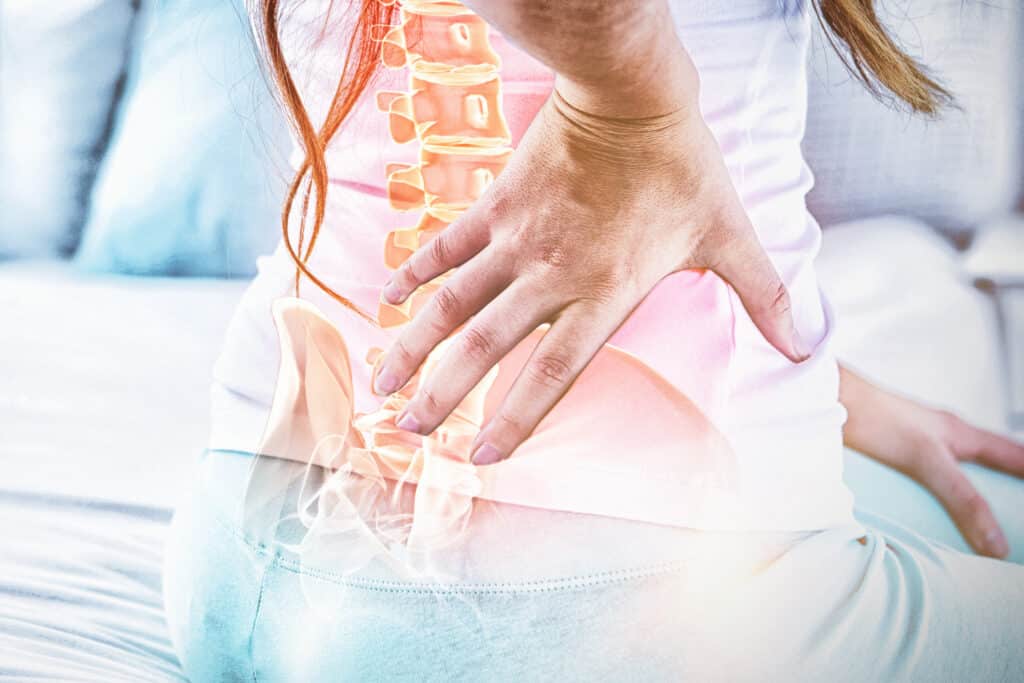
Struggling with back pain is no fun. And most of the time, we tend to blame the spine as the source of all our back problems. But is your back pain really coming from the lower back ?
In one of our previous blogs about back pain management, Back pain: Causes and Management we explained that there are many things that can happen in your lower back to cause pain.
Sometimes, the pain in your lower back might come from buttock, which is also called the sacroiliac joint. Yes, pain can be referred, and it is not because you experience pain across your back that the cause is necessarily coming from your back. There are structures above and below that are connected to your back that may be the source of your issue, and the sacroiliac joint is one of them.
So, what is the sacroiliac joint? And why may it be the source of your back pain?
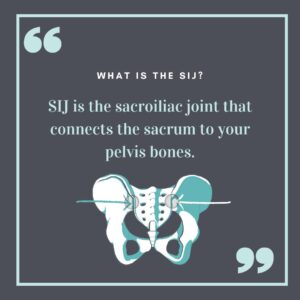 The sacroiliac joint is the joint that connects the sacrum to your pelvis bone. The joint is an important link in weight transmission to the lower limbs and is also a shock absorber for the lower back.
Again, there are many structures around the joint such as ligaments, muscles, tendons, connective tissues and so forth. And determining why the pain occurs in the area can be challenging.
Therefore, the term sacroiliac joint syndrome is the term used to describe people suffering from lower back pain or buttock pain coming from this area.
Sacroiliac joint syndrome is a significant source of pain in 15% to 30% of people with mechanical low back pain.
Sometimes, SIJ syndrome can also be mistaken with deep gluteal syndrome which is a new medical term to explain pain that is not coming from your disc.
The joint is a relatively stiff synovial joint filled with synovial fluid. The bones of the sacrum and ilium are coated in hyaline cartilage at their articular surfaces with dense fibrous tissue connecting the ilium and the sacrum.
Often, many people have been told that their pelvis is “out of place” or that the SI joint needs to be realigned with manipulation. SI joints typically only have a few degrees of motion, something around 2 degrees which is literally 0.3mm. So, it is tiny.
These claims are not valid because research has repeatedly shown that
- Sacroiliac joint syndrome is a condition that is difficult to diagnose and is often overlooked by doctors and physical therapists
- It is impossible for a practitioner to accurately diagnose the movement of the SI joint because its movement is so small.
What causes the sacroiliac joint to hurt?
Many of the cases (88% of them) are due to either repetitive microtrauma or acute trauma. There is a high prevalence of SI joint injury in athletes. 20% is also related to pregnancy, hormonal changes, and hypermobility.
You will probably feel some of the symptoms below if you are struggling with lower back pain due to sacroiliac joint syndrome:
- Lower back pain
- Pain in the buttock
- Sharp, stabbing, shooting, or burning sensations
- Mimic sciatic nerve pain
- Pain behind the back of your leg
- Pain while sitting down for long hours or standing for a long time
- Pain while climbing the stairs or bending forward
Does sacroiliac pain ever go away? What can I do to get better?
 An Osteopath can help with SIJ syndrome. In our clinic located in Busselton in the South West of WA, I (Teano / Osteopath) can assess your back problem and help you to find out if you have true back pain or referred pain. This will be the most important part of the consultation.
Yes, the pain can go away. Even though it is hard to know the exact source of SIJ pain, we know that successful treatment of the SI joint occurs when there is a multifaceted approach to pain.
This means that we need to address all the contributing factors of someones pain to be able to tackle the problem correctly. Therefore, it will take time to overcome the problem.
Osteopaths look at someones health, body, and lifestyle holistically. To address SIJ problems, we will do the following:
- Identifying the triggers (work ergonomics, physical activities, posture and so forth) and working actively on them can make a significant difference.
- Addressing other elements like stress, sleep, mental health and so forth will be important to have a holistic approach to your health.
- Assessing what you can do and what you cannot do and build a specific rehab program for yourself.
- Work on the tissues surrounding your back and your SI joint with some manual therapies such as spinal manipulation, massage, or other techniques which can create short-term relief to help you move asap.
Note: Hang on! We mentioned previously in this blog that manipulation on the SIJ isn’t worthwhile because its movements were tiny. So why would we suggest manual treatments?
The answer is not as easy as it seems. We know that SI joint movements are tiny but research also shows that manipulation in that area can relieve pain for a short time. So, massage or other manual treatments on the tissue around the joint can create some form of short-term release. It seems that these techniques do not move the joints or release your tissues but instead affect your nervous system which is the system that is producing pain.
When pain is difficult to deal with, using manual treatments can help you to engage with your exercise rehabilitation. Sometimes medications such as anti-inflammatory or corticosteroid injections can also be a tool to support your recovery.
Many people are also asking me about braces and belts to support their body. Again, like I say to many people coming into my clinic, these approaches (manual treatments, belts or braces and medications) can be considered as passive approaches which means that it is more like a band-aid fix. It does not address the root cause of the problem.
Many other remedies are available for SI joint pain, but their efficacy is dubious. So far, exercises and a pain management plan that unload the inflamed area can be a good avenue. Sometimes, when we are in pain, we are worried about moving or tend to protect the area in pain at all costs. This approach can make things worse, and it is important to keep yourself mobile while you are recovering. Sometimes, having some movement ideas can help which iss why I’ve made this video to give people some ideas of movement that they can implement today.
Now if you are experiencing persistent pain in that area and have been avoiding movement for a long time, the task won’t be easy, but it will be important to actively reengage with an exercise program that fits your needs.
Getting some guidance and help from an Osteopath can help you remove the guess work, have a plan of action, and do the things you love again.
If you are not sure about Osteopathy being the best avenue for you and if you don’t feel that we are the right fit for you during our initial assessment, let us know and we can stop the session at no cost to you.
